

Dürer in Zofingen: «Melencolia I» and «Saint Eustace»
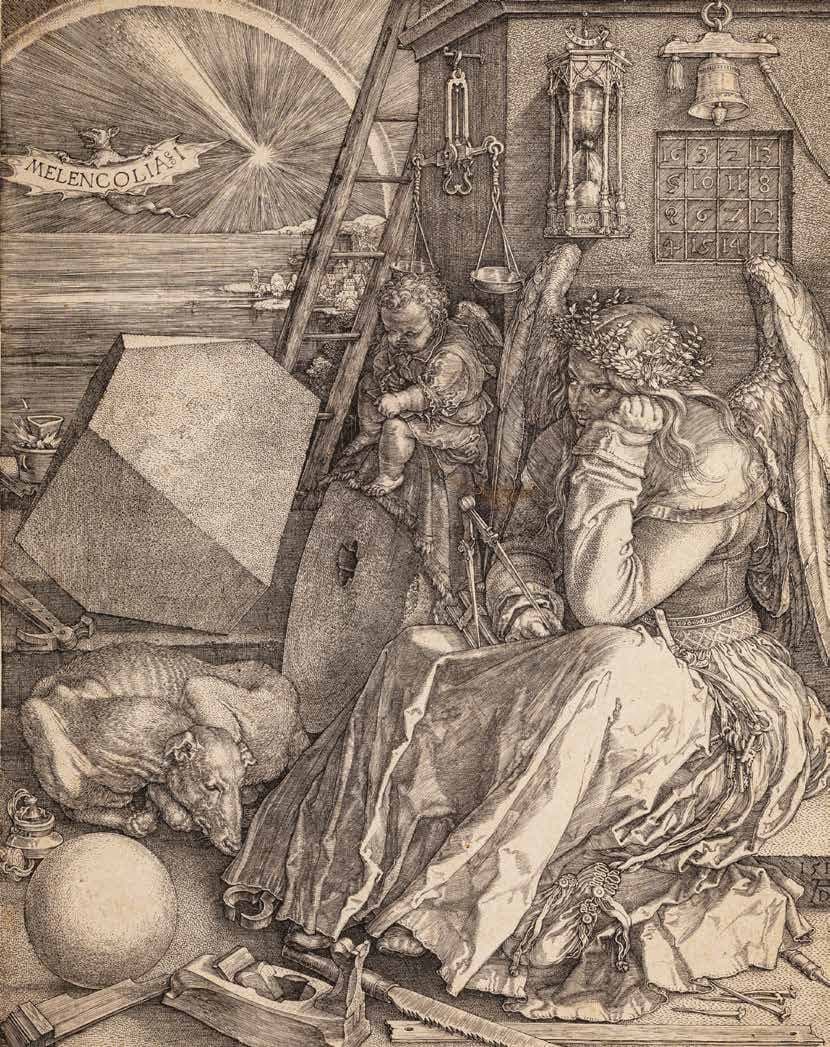
Some works of art invite contemplation — others develop an intensity that lingers. Albrecht Dürer’s «Melencolia I» of 1514 belongs to the second category: its meaning has been analysed for more than five hundred years, to this day without a definitive answer. A pensive, angelic figure sits amid unused tools — full of creative will, yet unable to accomplish anything. Those who look more closely will find Dürer’s magic square on the wall: sixteen numbers whose rows, columns and diagonals always add up to 34.
A witness to its time on laid paper
The impression on offer, printed on laid paper and dated between 1520 and 1550, comes from the period immediately after Dürer — estimated at CHF 20,000. Minor signs of age are a reminder that this sheet has survived half a millennium.
Dürer’s largest engraving
The «Melencolia» was complemented by «Saint Eustace» (also known as «Saint Hubert»), which at 35.5 by 25.8 centimetres is the largest engraving Dürer ever made. The sheet depicts the moment in which a cross appears to the Roman general Placidus in the antlers of a stag. Vasari himself praised the beauty of Dürer’s hunting dogs in the foreground — with a simple burin, Dürer created a world of extraordinary density of detail.
Both prints were offered at the Spring Auction 2026.