

Hauswirth and Saugy: Swiss papercuts from the Haldi Collection
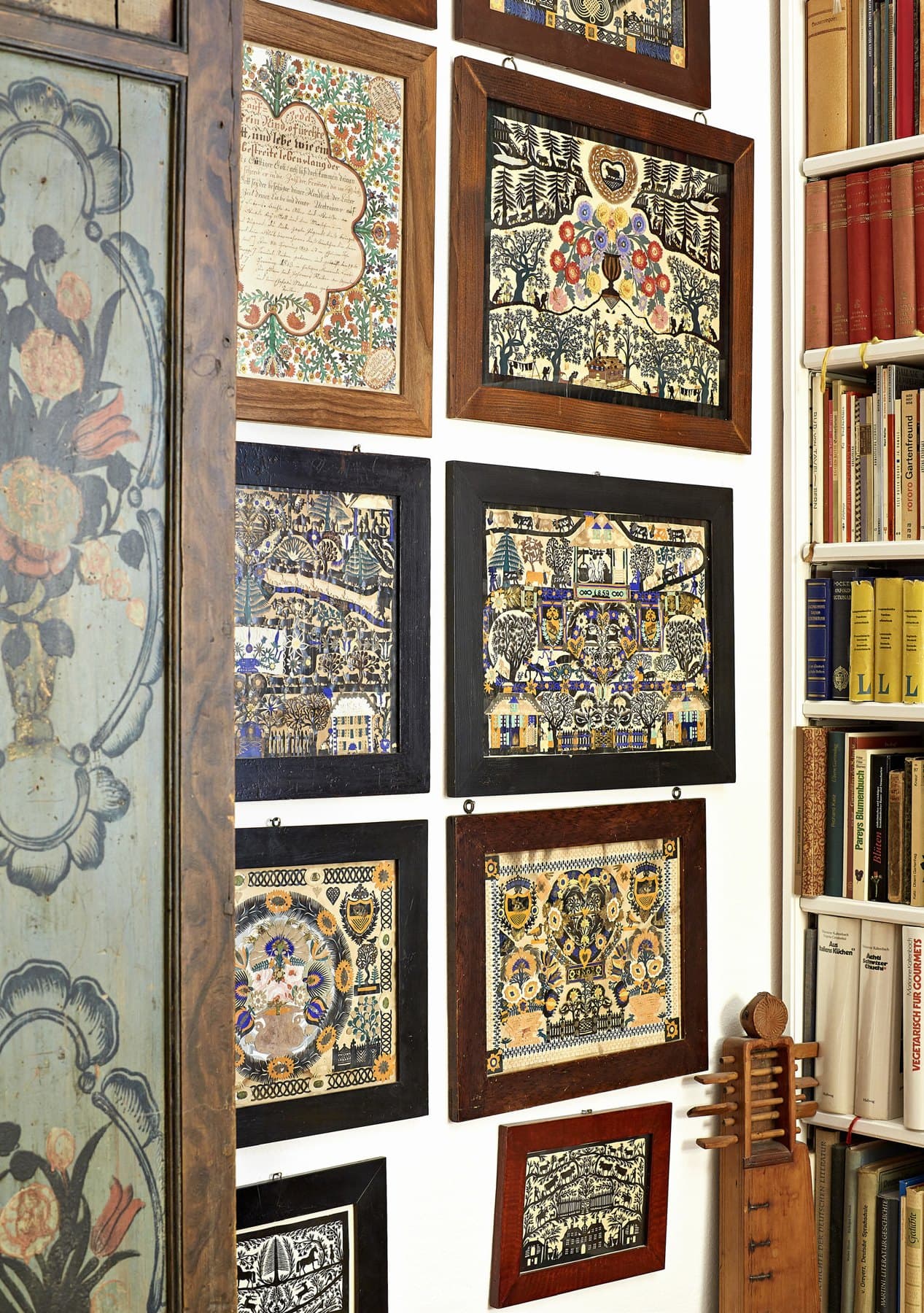
In Switzerland, the art of papercutting goes back to the 17th century. Originally cultivated as a sociable pastime of urban middle-class families, the artful cutting of paper soon found its way to the countryside: in the evenings, people would gather to create silhouettes and ornaments with scissors and paper.
The farmhand with the wire rings
In the Pays d'Enhaut, the papercut enjoyed a golden age. This is where Johann Jakob Hauswirth (1809-1871) worked, a simple farmhand and day labourer who is regarded as the founder of the Swiss papercutting tradition. He created filigree works without any preliminary drawing; to guide the scissors with his large, clumsy hands, he attached wire rings to the handles. His scenes show rural life — cattle drives up to the alpine pastures, cheese dairies, hunts, festivities — fused with decorative elements into imaginary worlds.
Louis David Saugy (1871-1953) from Rougemont continued the tradition. As a postman he entered many farmhouse parlours and drew inspiration from Hauswirth’s work. His papercuts are more dynamic, often enriched with individually cut and glued-on figures.
The papercuts from the Haldi Collection were offered at the Autumn Auction 2024 — a large floral bouquet by Hauswirth followed at the Spring Auction 2025.